
By John Bozzella
I’m back from Europe, where I toured the Paris Motor Show and attended a gathering of the world’s leading automotive trade associations.
There’s no sugarcoating it…
What I saw in Europe relative to Chinese vehicles is a cautionary tale for the United States.
And it’s why I’m convinced (now more than ever) that Congress must enact a ban on the sale, manufacture and import of Chinese connected vehicles before adjourning this year.
My dispatch from the front:
More than 20 Chinese vehicle brands had exhibits at the Paris Motor Show. That’s up from nine a couple years ago and almost as many as European auto manufacturers.
Chinese automakers also made major product announcements and staked out aggressive growth plans.
One trend: Full-size, luxury, electric SUVs from Chinese brands like Xpeng and BYD. The latter already has 14 models available for sale in the French market (I rode in a few of them) and is eyeing 200 dealers there by the end of 2026.
Auto insiders from Europe and other parts of the world told me they’re worried about the impact of Chinese automakers on their domestic markets and industrial bases.
You can’t blame them.
Driving the anxiety: Chinese automakers notched a 7.8 percent new-vehicle market share in Europe in 2025 – up from 1.7 percent a decade ago.
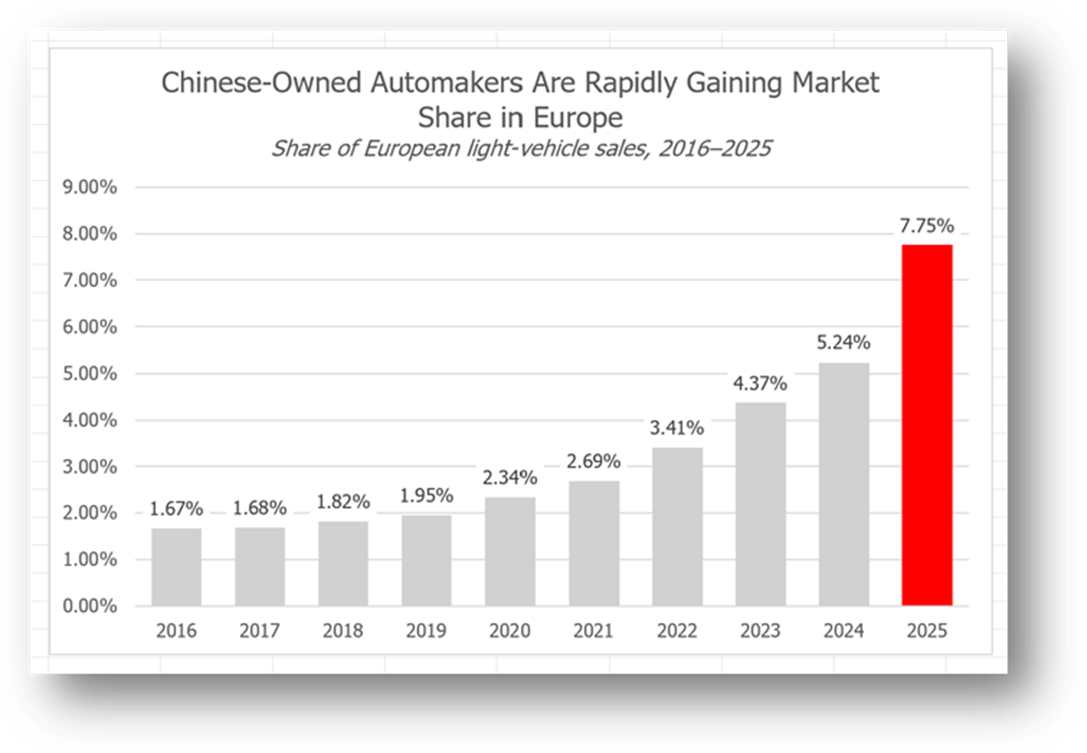
(Source: Omdia, World Vehicle Sales; 2016-2025)
Meanwhile, China’s overheated domestic auto market is facing a reckoning. In September, passenger vehicle sales were down 28 percent year-over-year, while exports were up 73 percent.
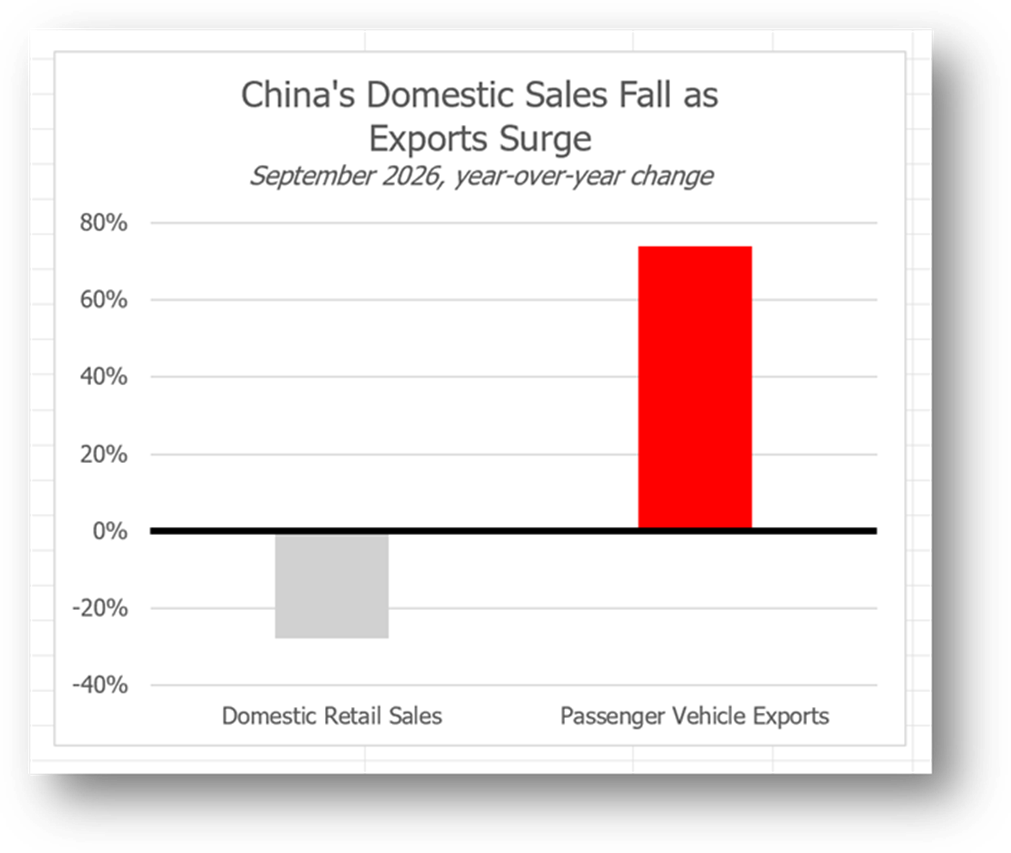
(Source: Reuters; October 12, 2026)
Too many subsidized automakers chasing too few buyers in China… leading to the heavy discounting we’re seeing across Europe. All of it is weighing on Chinese profitability.
To its credit, the European Union is responding to these shifting market dynamics.
Hindsight is 20/20, but it’s clear that waiting to address these imbalances after Chinese automakers have flooded the continent (with few restrictions) has made this more challenging.
I was in Paris while the EU and China were finalizing a deal to cap the import of Chinese hybrid and plug-in hybrid vehicles at 350,000 units annually. The four-year agreement could take effect as soon as December and would halve Chinese hybrid market share in the EU.
The EU is pairing the import restrictions with a “Made in Europe” industrial policy backed by France and Germany that would require Chinese automakers to build in Europe with high European content, local workers and localized supply chains.
That Europe needs to require that kind of localization is another argument for preventing Chinese automakers from manufacturing here.
Even if permitted access to the U.S. market, there’s no guarantee that domestic assembly of Chinese vehicles (by companies owned and operated by the Chinese government) equals new American jobs or local supply chains. (See what happened to Thailand’s industrial base).
Anyway, “Made in Europe” isn’t a done deal, but the data gives you a sense of why they need to act (and fast).
In the first eight months of 2026, the EU imported more than 1.1 million vehicles from China. That’s more imports than all of 2025.
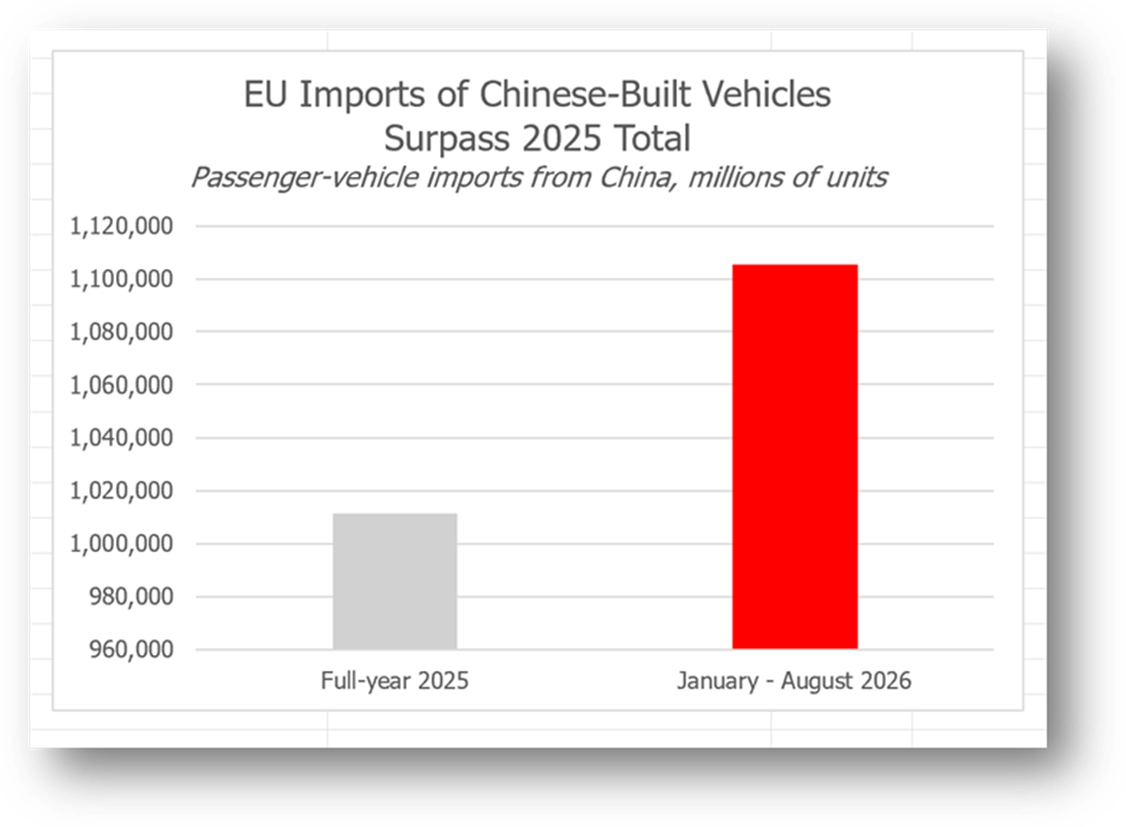
(Source: Association of European Vehicle Logistics; October 23, 2026)
No wonder Europe’s worried about manufacturing jobs and a hollowing out of its industrial base.
The question is: Can Europe’s mid-course correction work?
Can these policies put the genie back in the bottle now that Chinese vehicles have a foothold in Europe?
Here in the U.S., we’re having a similar policy debate about Chinese vehicles, advanced manufacturing and industrial policy – but on more favorable terms.
The current and previous administrations, and now Congress, have the policy sequence right.
First, we’ve blocked Chinese vehicles inside this country via tariffs and national security rules.
Now, Congress is considering making a permanent ban on Chinese vehicles the law of the land.
But compared to Europe and other global markets, the U.S. has leverage and room to get the details right without hitting the panic button.
That’s the right order and what should happen in the lame-duck session. Congress deals with the national security issues of Chinese vehicles first – on the front end – before we wake up to a fleet of roving surveillance machines on our roads and an erosion of our largest manufacturing sector.
By the way, backing a Chinese vehicle ban doesn’t mean putting up walls around the U.S. or turning us into an island market.
You have to do two things: protect and promote.
Yes, we need to protect the U.S. market from a flood of Chinese imports that carry surveillance risk and disadvantage current manufacturers that have made generational investments in American communities.
But you also need to promote the industry, so it remains globally competitive in the long run.
That includes competitiveness platforms like the United States-Mexico-Canada trade agreement; making sure we have a balanced and stable approach to vehicle emissions regulations that aligns with market trends; and policies that support investment in and the deployment of advanced vehicle technologies.
For most of 2026, we’ve said to policymakers:
Given the obvious national security risk and China’s pattern of unfair behavior, Congress should protect our defense and advanced manufacturing base and stop Chinese automakers from doing here what they’ve gotten away with in Europe.
Europe is a cautionary tale.
It’s much harder to reverse the geopolitical trends that led to a surge in Chinese vehicle exports… once they’re embedded in your domestic market.
Much harder. Maybe impossible.
Automakers in the U.S. can compete on technology, engineering and great design. But companies should be competing with other companies. What we have now is companies competing with countries.
Congress should act now to pass a Chinese vehicle ban that addresses national security risk and China’s history of anticompetitive behavior – before Chinese manufacturers ever have access to the U.S. market.
That’s the right policy. And the right order.
John Bozzella is president and CEO of Alliance for Automotive Innovation.
About Alliance for Automotive Innovation
From the manufacturers producing most vehicles sold in the U.S. to autonomous vehicle innovators to equipment suppliers, battery producers and semiconductor makers – Alliance for Automotive Innovation represents the full auto industry, a sector supporting 11 million American jobs and more than 5 percent of the economy. Active in Washington, D.C., and all 50 states, the association is committed to a cleaner, safer and smarter personal transportation future. www.theautos.org